
Description
Padiusir 1
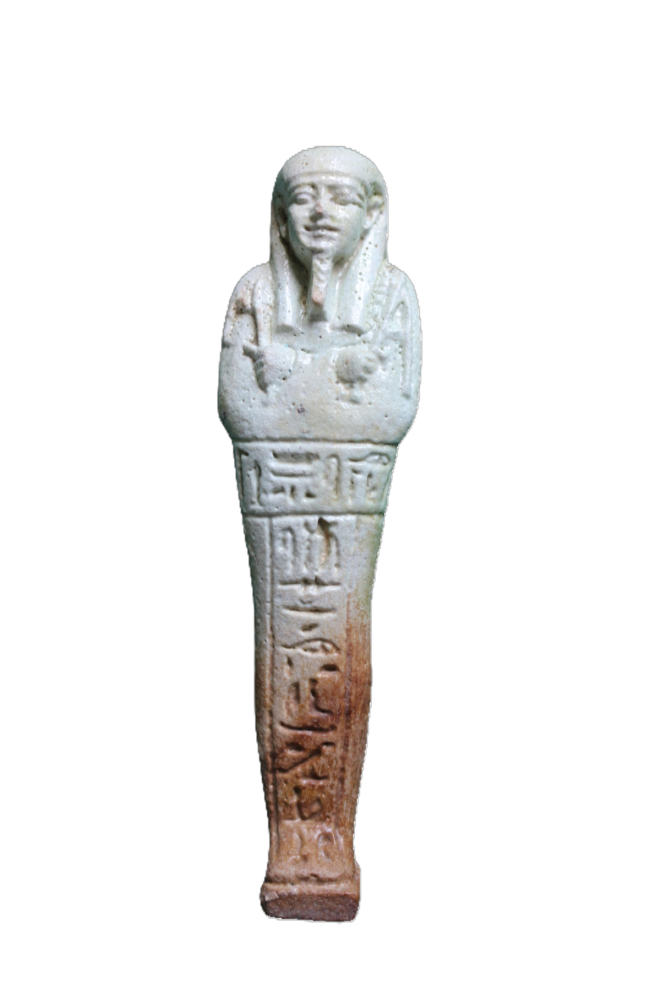
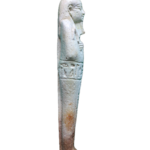
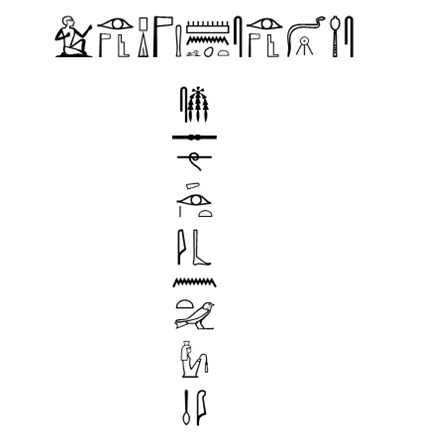
Funerary servant of worker statuette in pale-blue faience. It displays a brownish coloration on the lower part, perhaps due to oxidation. It wears a plaine tripartite wig that leaves the ears visible and extends onto the chest. The face is finely modeled, with cosmetic lines around the eyes and carefully rendered details of the mouth, nose, eyebrows and chin. It has a braided beard. The crossed hands project from the mummy casing and hold a pick in the left hand and an adze in the right. This hand also grasps the rope that passes over the shoulder and secures the seed bag at the back, decorated with a braided pattern. The figure has a dorsal pillar and a pedestal. The inscription is arranged in a T-shaped layout framed by lines, with the text running from right to left and, in the vertical column, from top to bottom.This arrangement supports the proposed dating of the ushebti.
Hieroglyphic transcription
Comments
Henri Charles Loffet’s study2 has shown that a homonymous individual, of the same filiation and likewise a prophet of the lioness godess Semenet, probably identical to the owner of the ushebti”under study, was also a prophet of T”he Mansion of Ptah, who resides in Neni-nesut”. Consequently, Padiusir was probably a priest attached to a sanctuary dedicated to the god Ptah at Heracleópolis, perhaps in the great temple of Herishef rebuilt by Ramesses II, and was also likely buried in one of the necropoleis of the region. The name of his mother, Setchairetbinet, means “May the evil eye depart” (Ranke PN I, 323, 1 & II, 389).
In the hieroglyphic inscription, the sign V2 (“sTA”), has been identified, following Loffet’s trancription in connection with the ushebti bearing Chapter VI of the Book of Dead inscription, although it may instead represent the hand sign (D46) , as commonly occurs on ushebtis of this individual with T-shaped inscriptions. The statuette studied here was acquired at auction3.
Padiusir
PA-dj-wsjr
Current location
Private collection. Bizkaia.
Origin
Probably from Heracleópolis region.
Ancient Dr. D. París collection.
Material
Pale blue faience.
Dimensions
12,8 x 3,5 x 2 cm.
Dating
Late Thirtieth Dynasty, early Ptolemaic period..
Bibliography
Unpublished.
For other parallels, see:
KURTH, Dieter. 2018. “Hausgrabungen”. Band 2. Aegyptiaca in deutschen Privatbesitz. Hützel. p. 72-76, no 7.
LOFFET, Henri Charles. 2020. “Un bien mystérieux Pa-di-Ousir, né de la dame Setcha-iret-binet”. Égypte Nilotique et Méditerranéenne (ENiM) 13. 79-92.
Typology
5.3.1 Cl: XIA3 / W36 H4 I8 B26b A0 Tp:6
Transliteration
sHD wsjr Hm-nTr smnt p(A)-dj-wsir ms (n) sTA-jrt-bjnt mAa-xrw
Translation
Horizontal line: May be illuminated the Osiris, the prophet of Semenet, Padiusir.
Vertical column: Born of Setchairetbinet, justified.
Author of this record
©J. Ortuondo