
Description
Nitocris1
Unpublished bibliography2
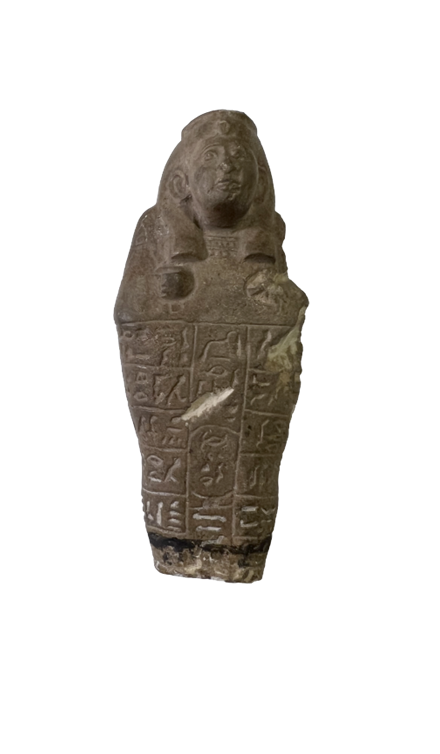
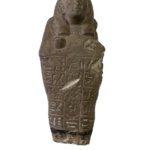
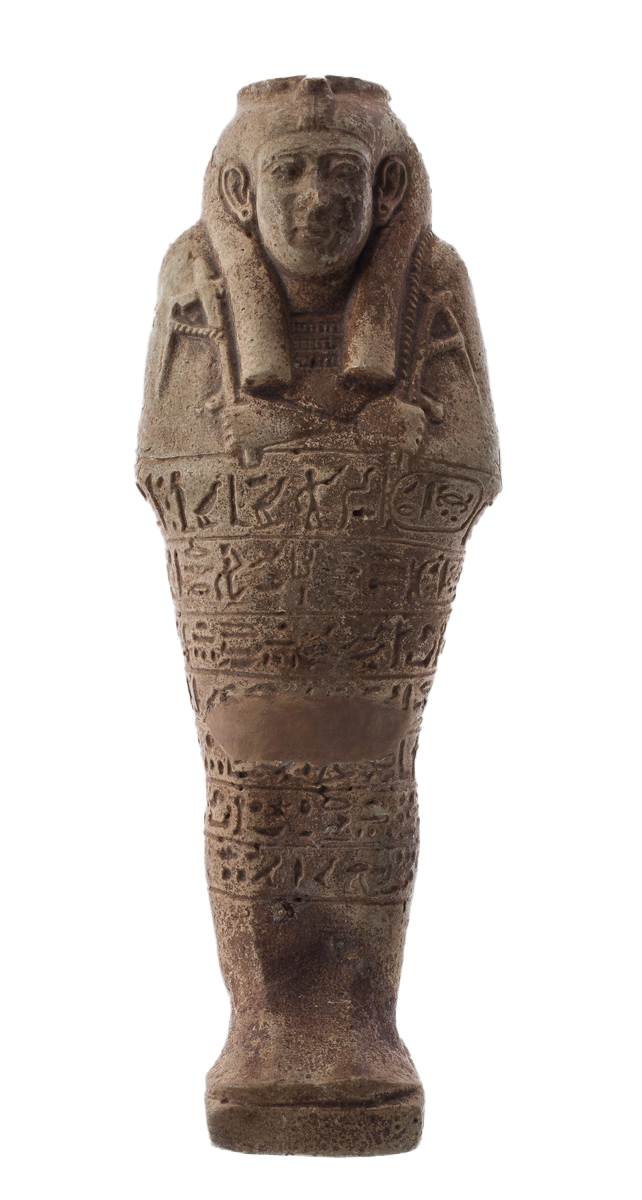
Upper fragment (3/4 of the total figurine) in brown-toned faience. Mummiform. With dorsal pillar. Tripartite wig, topped at the upper part by a circular base. On the forehead, the uraeus, symbol of her royal lineage. Two-strand usej collar, with garlands.
The hands are assumed to be crossed and the arms are not visible. The left hand holds a hoe, in relief, and the right a pick and the rope. On the back, over the left shoulder blade, traces of a woven sack.
Well-defined facial features, in relief. Mouth, nose, eyes, eyebrows, and ears are perfectly visible. The face is somewhat chubby.
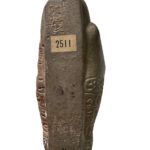
On its left side, just below the shoulder, the piece has suffered partial loss, perhaps due to a blow.
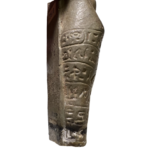
The text consists of one frontal column and five horizontal lines around it, containing a version of Chapter VI of the Book of the Dead3.
On the circular base of the head it probably once bore some kind of ceremonial headdress, possibly two tall feathers of precious metal8, which must have been removed at the time the tomb was looted.
Hieroglyphic transcription

Comments
Nitocris, daughter of Psamtik I (664–610 BC), a pharaoh of Saite origin, was sent to Thebes to hold the office of Divine Adoratrice and God’s Wife of Amun. Her Egyptian name, Nit-iqrt, means “Neith is excellent,” Neith being the protective goddess of the city of Sais.
Other titles held by Nitocris were God’s Hand and The Great One, as well as King’s Daughter.
In the Egyptian Museum in Cairo is the so-called Adoption Stela of Nitocris4, discovered in the Temple of Amun at Karnak by the Egyptologist Georges Legrain in 1897. It describes the conditions under which Psamtik’s daughter arrived in Thebes to become heir to the title of Divine Adoratrice, the highest title of the Amun clergy at the time, then held by Shepenupet II. In order not to depose her and create a political conflict, she was adopted by Shepenupet, thus strengthening Saite influence in Upper Egypt5. One of the main functions of the new Divine Adoratrice was to invoke the god Amun to protect the king, her father.
Known parallels for this ushebti exists in the Cairo Museum6 and in Chicago7.
This specimen is part of the acquisitions made by the National Archaeological Museum in 1879 from Mr. Víctor Abargues. The file for this acquisition can be consulted at the following link.
Nitocris
Nit-iqrt
Current location
National Archaeological Museum, Madrid.
Inv. Nº
2511
Origin
West Thebes (Medinet Habu)
Donation from the Víctor Abargues collection (1879)
Material
Faience
Dimensions
11.6 x 4.8
Dating
26th Dynasty
Bibliography
Unpublished
Typology
5.3.0 Cl: XA1/ W35b H30 I7 B26 A0 Tp: 3b
Transliteration
Dd-mdw n Wsir Hmt Nit-iqrt m3a-Hrw
Translation
Words spoken by the Osiris of the God's Wife, Nit-ikeret (Nitocris), justified.
Author of this record
©Javier Uriach