Description
Ankhor1
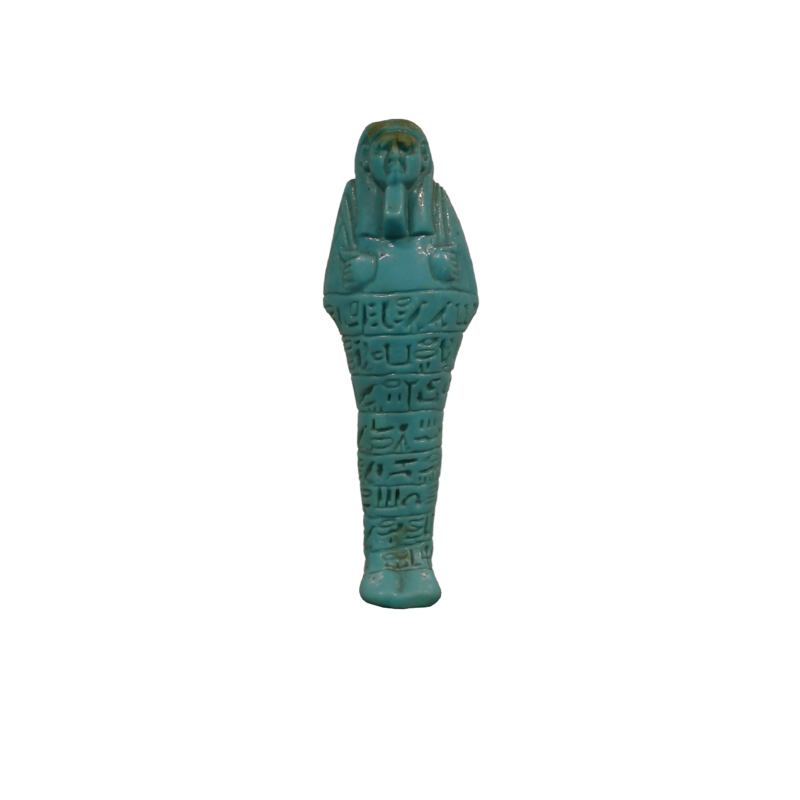
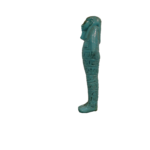
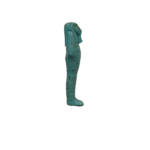
Mummiform statuette, of turquoise blue faience with a matte finish.
It lacks the dorsal pillar and trapezoidal base so characteristic of the Late Period. Also noteworthy is that as tools it carries only a hoe on its right side while on the left a rope emerges ending in a seed bag, visible on its back.
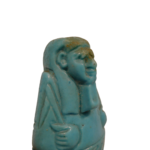
The general features are somewhat peculiar, highlighting its rounded face, large nose, thick lips, bulging eyes, large ears and prominent hands where all five fingers are clearly visible. The false beard acts as if it were a buttress.
The text consists of nine rows: The first begins its reading from the back, at the height of its right shoulder and continuing to the left. It contains his name and titles. The following eight rows wrap around the mummiform body and are separated by a column.
Hieroglyphic transcription

Comments
Statuette acquired at auction2
Ankhor was an important figure whose tomb (TT414) is located in the Asasif area. The tomb, the fourth largest in the Theban necropolis, was known since antiquity and remained open until the 19th century. Most of the shabtis now preserved in museums and private collections come from that period3. Subsequently, in 1971, the tomb was rediscovered and excavated by Austrian archaeologists Manfred Bietak and Elfriede Reiser-Haslauer. As a result of their work, a new shabti came to light4.
According to the inscriptions on the south wall of his tomb, Ankhor held a total of sixteen titles5, among which stood out “Governor of Upper Egypt” and “Chief Overseer of the Divine Adoratrice”6.
Everything indicates that he was appointed during the reign of Psamtik II and still held the position under the reign of Apries.
Nevertheless, it appears that the titles of Governor or Overseer had a more honorific than executive character.
This statuette presents an infrequent characteristic compared to most known examples: the text begins at shoulder height, on its back, instead of on the wig7.
Another noteworthy feature is the presence of a single agricultural implement, accompanied by a rope and a sack. This iconographic detail is also documented on the shabtis of Padihorresenet, Padimahes, and King Senkamanisken, all of which date to the Late Period 8.
The inscribed text corresponds to a late variant of Chapter VI of the Book of the Dead, specifically to version VIIA.
Ankhor
anx-Hr
Current location
Private collection. Barcelona.
Origin
El-Assasif (TT414)
Ex Bodo Bless collection
Material
Turquoise blue faience
Dimensions
10.8 x 4.0 x 1.8
Dating
26th Dynasty
Bibliography
Unpublished for this example.
On the individual: see Janes 2002 (p.154-155), Berman 1999 (p.450), Aubert (plate 55), Janes 2024 (p.160-161), Laurent 1997 (p.95-96), Meffre 2026 (p.47-50).
Typology
5.3.1. Cl: XA4/W34 H23 I9 B26a TP:2b
Transliteration
Dd mDw wsir imy-r Smat anx-Hr m3a-xrw i wS3btyw ipn ir.hsb tw wsir anx-Hr m3a-xrw i ir.t k3t irt im m Xrt-nTr is Hw sDb im m s r Xrw.f mk wi k3.tn…
Translation
Words spoken by the Osiris, the Governor of Upper Egypt, Ankhor, true of voice: O these shabtis! If you are called, if you are required by the Osiris of Ankhor, to perform any of the tasks that must be done in the necropolis – as a man before his responsibilities – here we are, you shall say…
Author of this record
©Javier Uriach