
Description
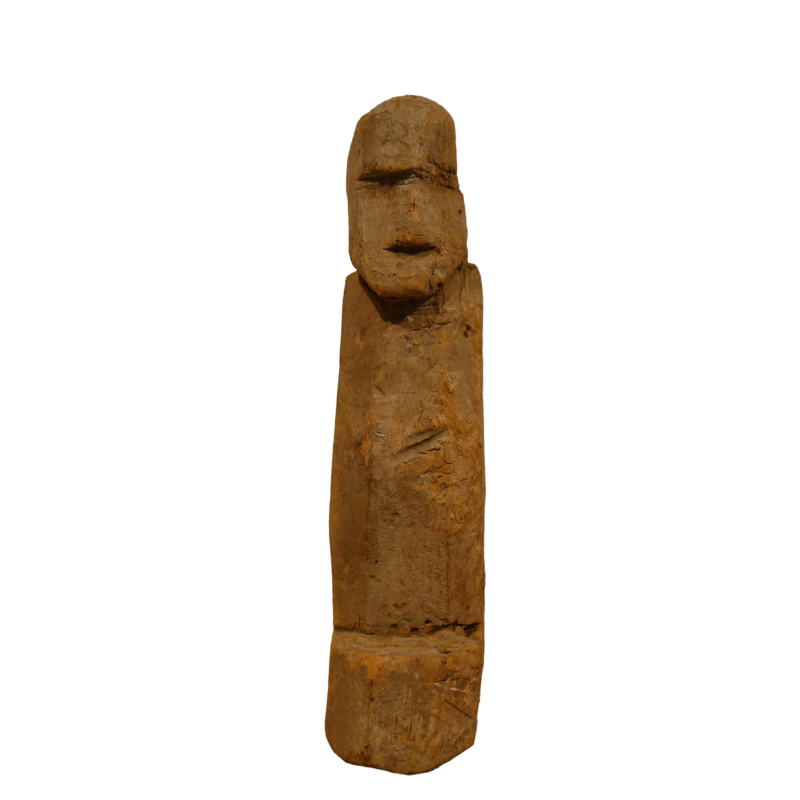
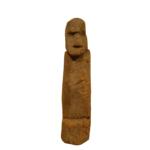
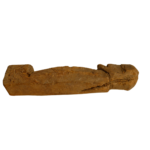
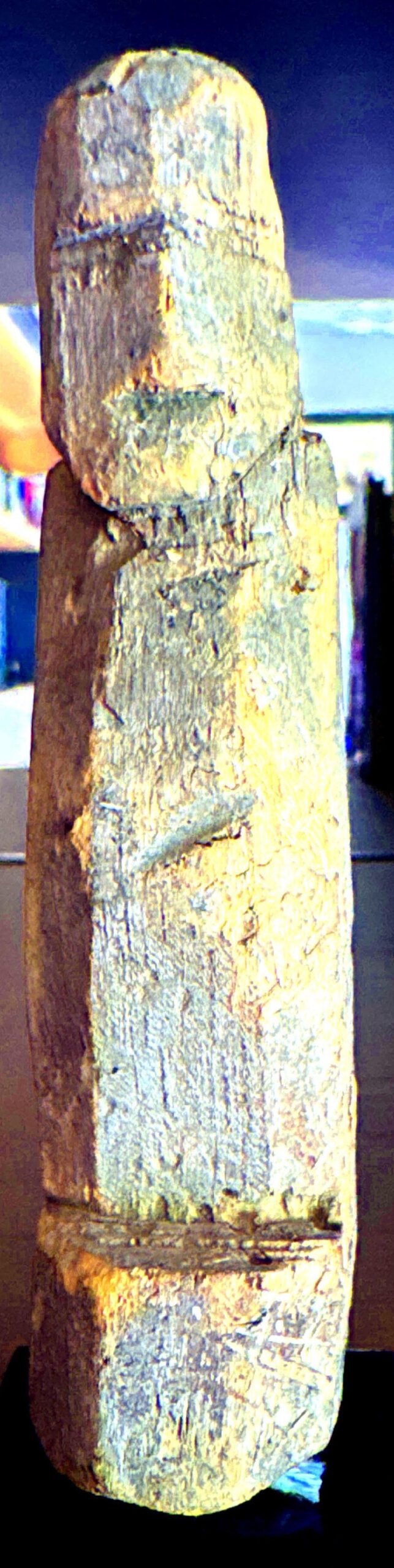
Wooden figurine executed in a very crude manner, resembling a mummified body wrapped in bandages. The head would represent the funerary mask. It has no wig. The hands are not visible either. The face is notable for its enormous chin. Eyes and mouth are notches carved into the wood, while the nose effect is produced by the recessing of the cheeks. The base of the feet resembles the foot of a sarcophagus.
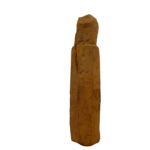
On the back, the vertical cuts made with a chisel or gouge to shape the piece of wood are still visible. Also notable is a crack running from the center of the back, on its left side, to the head, at what would be the upper part of the ear. Similarly, on the front there is a notch in what would be the belly.
No inscription of any kind is detected.
Comments
Figurine acquired at auction, within a lot of several pieces1.
This type of figure was given the name stick shabtis, as pieces of wood were basically used for their manufacture.
The technique employed in their manufacture is similar to that used in the production of anthropoid coffins of Dynasties XVII and early XVIII: a wedge-shaped section is removed from the upper half of a piece of wood, thus creating a recess that defines the chin line of the face, while accentuating the upper part of the chest. The same procedure is followed with the lower part to shape the feet2.
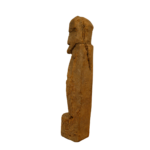
The figurine, viewed in profile and face up, clearly recalls a mummy in its sarcophagus.
Generally, this type of figurine bears an inscription that identifies it and usually begins with the standard offering formula (Htp-di-nsw and prt-xrw). Hieratic constitutes the most frequent writing modality in these specimens.
In the present case, no trace of inscription has been preserved, if it ever existed. Through the application of pigment analysis techniques, facilitated by the id stretcht software, it has not been possible to detect any vestige of polychromy (see). It is possible that this shabti was not intended for a specific deceased person, but rather served a votive function.
Anepigraphic
Current location
Colección particular. Barcelona.
Origin
Dra Abu el Naga
Former Bodo Bless collection
Material
Light wood, possibly sycamore.
Dimensions
12.8 x 2.9 x 3.0
Dating
Dynasty XVII
Bibliography
Unpublished
Typology
2.1.3 Cl: IVC1/ W0 H0 I0 B0 A0 Tp:0
Author of this record
©Javier Uriach