
Description
Seti I 1
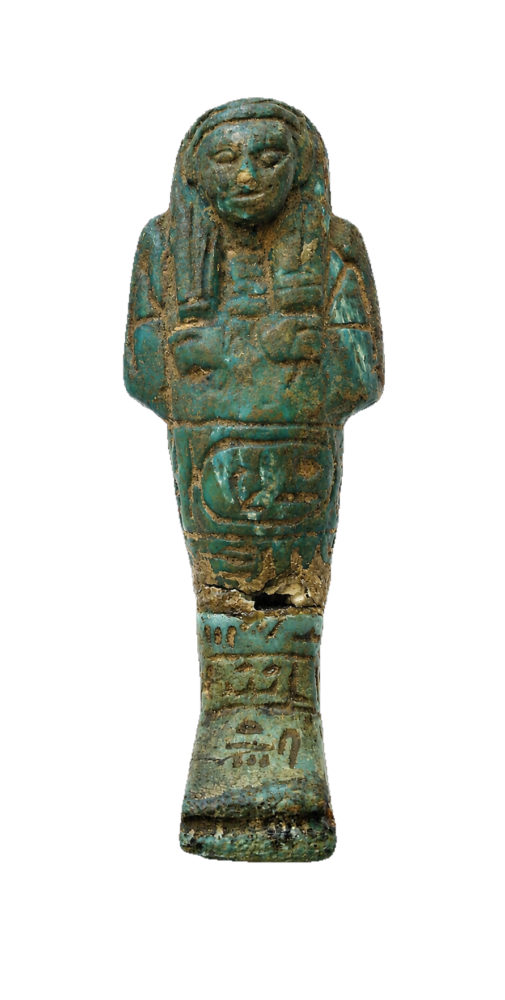
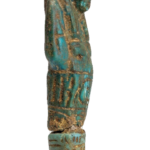
Mummiform statuette of glazed steatite (the manufacturing process involved carving the stone and then baking it until its outer layer crystallized, fragmented into two parts). It shows small areas of abrasion.
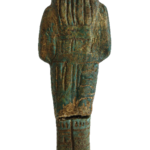
Striated tripartite wig. Recognizable facial features: ears, eyes, nose, and mouth. Arms supposedly crossed. Thumbs protrude from the hands. Each fist grips a hoe. At the back, beneath the wig, a rectangular sack is visible.
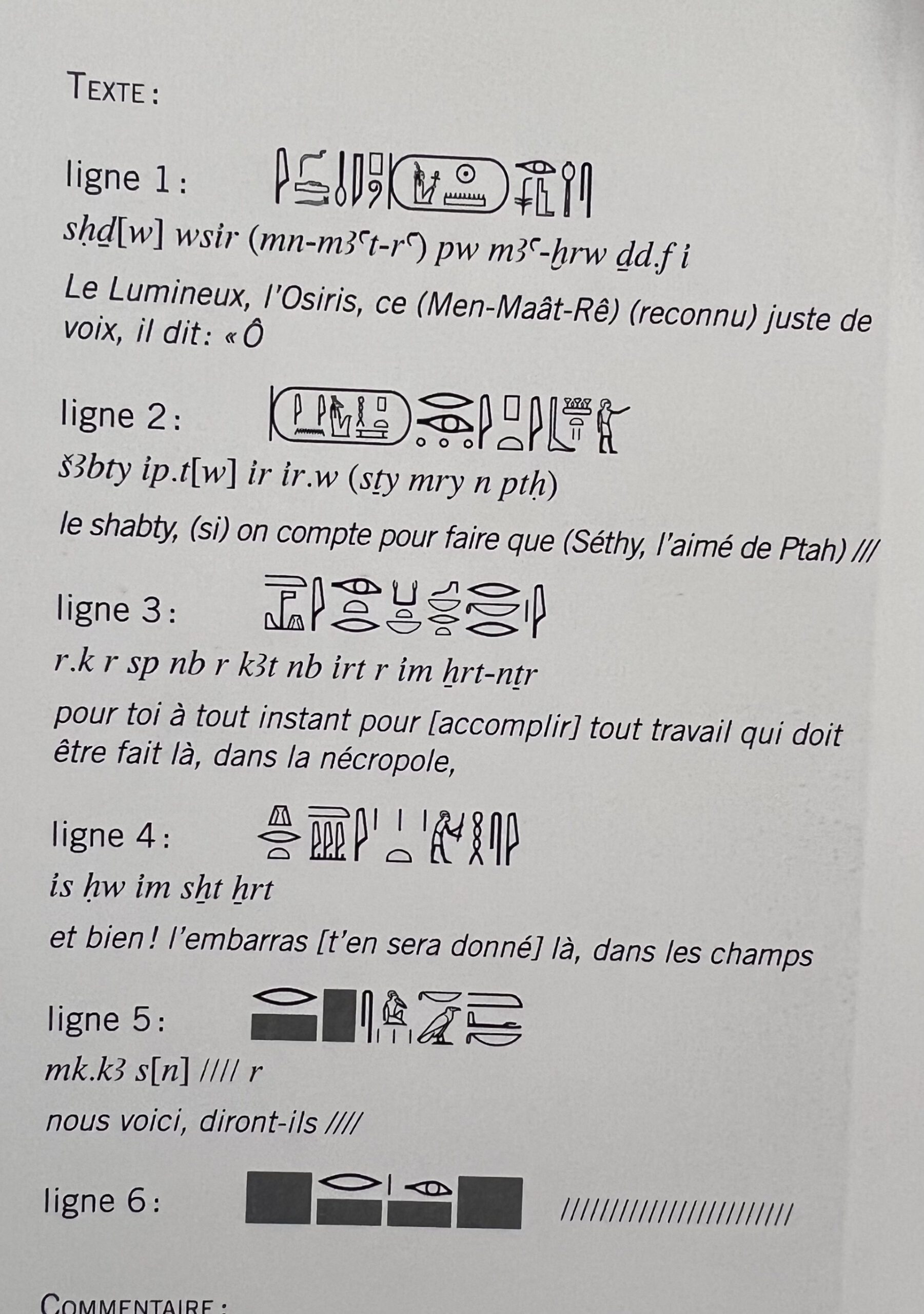
The inscription is horizontal and consists of five lines (read from right to left).
Among the known specimens, this example (along with the one in Florence) is the only one that preserves the lower part, although it could be a fragment from another statuette.
The reading of the first two lines corresponds to the transcription given by Loffet, while the other three bear no resemblance to those of the French Egyptologist3
Hieroglyphic transcription


Comments
This specimen was acquired at auction 4
Pharaoh Seti I is one of the great rulers in the history of Ancient Egypt. His tomb (KV17) is located in Biban el-Moluk, Valley of the Kings, on the west bank of Thebes. Seti I’s tomb, one of the most spectacular in the royal necropolis, was discovered by the Italian adventurer Giovanni Belzoni in 1817. Although it had been plundered in antiquity, it still contained part of his funerary equipment, mainly the collection of shabtis. It is estimated that the total number of funerary statuettes found in KV17 exceeded 700. Seti I’s shabtis are, for the most part, made of wood. Examples of Egyptian faience are not uncommon, while stone (steatite) shabtis are extremely rare 5
They are small in size and inscribed with an excerpt from Chapter VI of the Book of the Dead around the lower part of their body. The text notably features the royal cartouche with his throne name: mn-mAat-Ra.
This shabti may have been part of the Drexel collection, assembled by Egyptologist Emil Brugsch with funds from the Bulaq Museum in Cairo in 1895 for the Drexel Institute, Philadelphia. In 1916, it passed to the Minneapolis Institute of Arts, reaching the antiquities market in the 1950s. It was auctioned in 1973 by Superior Stamp & Coin Company, Los Angeles. Subsequently, in 2005, it was acquired by a private Spanish collector.
Seti I
Mn-M3at-Ra
Current location
Private collection. Melilla.
Inv. Nº
1
Origin
Valley of the Kings (KV17)
Material
Glazed steatite
Dimensions
6.4 x 2.3 x 1.7
Dating
Dynasty XIX
Bibliography
published (see note 2)
Typology
3.2.0 Cl: 3.1.0 / W7 H30 I5 B9a Tp:1c
Transliteration
sHD wsir (Mn-m3at-ra) pw m3a-xrw Dd.f i Sbty ip.t (w) ir ir.w (sTy mry n ptH)
Translation
Illumination to Osiris Menmaatre, recognized as justified of voice. He says: Oh
Shabti, if you are called upon to make Seti, the beloved of Ptah…
Author of this record
M.A.Escobar / J.U.