Description
Padiamon1
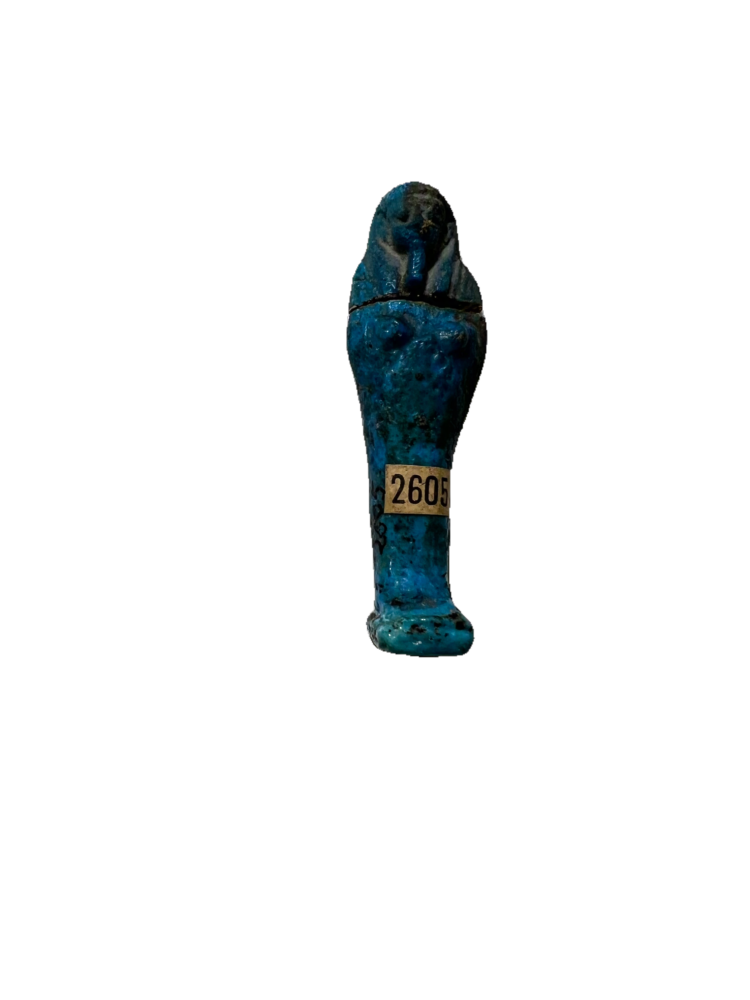
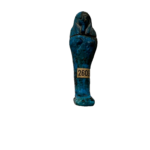
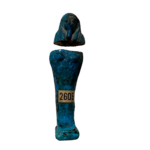
Mummiform statuette in bright blue faience. The piece is fragmented into two parts, with one fracture below the beard and another above the arms.
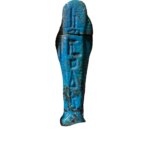
Plain tripartite wig and false beard. The facial features, though heavily eroded, are still perceptible; the ears are clearly visible. The arms are not distinguishable, though the hands appear crossed over the chest. The tools are barely perceptible. On the back there is a dorsal pillar. On the left side hangs a latticed sack vertically. The inscription runs longitudinally along the dorsal pillar, from the wig to the heels.
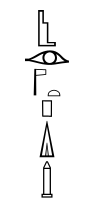
Hieroglyphic transcription
Comments
The name Padiamon is quite common during the Third Intermediate Period and the Late Period. Perhaps the best known is the one corresponding to the statuette found in the second cachette at Deir el-Bahari, whose owner held the title god's father or divine father. The MAN specimen also bears this same title, which gives an idea of the relevance of its owner.
What is truly curious about this specimen is the sign used to write the name of Amun: the obelisk (Gardiner O25). As A.A. Spartak notes, from the New Kingdom onward the obelisk sign (txn) begins to be used with the value m+n, appearing in words such as mnw (monument), Imn (Amun), or Ymn (to hide) 2.
There are other ushabtis of Padiamon from this same Saite period that are very similar, though with the inscription arranged on the front. It could be the same individual, although this cannot be stated with certainty. The specimens are preserved in Liverpool and Calcutta 3.
Padiamon
P3-di-Imn
Current location
National Archaeological Museum, Madrid.
Inv. Nº
2605
Origin
Unknown
Material
Faience
Dimensions
7.2 × 2.2 × 1.6
Dating
26th Dynasty
Bibliography
Unpublished.
Typology
5.3.1 TC: XIc W35b H30 I6 B5b Tp13c
Transliteration
Wsir it-NTr P3-di-Imn
Translation
Osiris (of the) god's father Padiamon.
Author of this record
©Javier Uriach