Description
Hathoremhat1
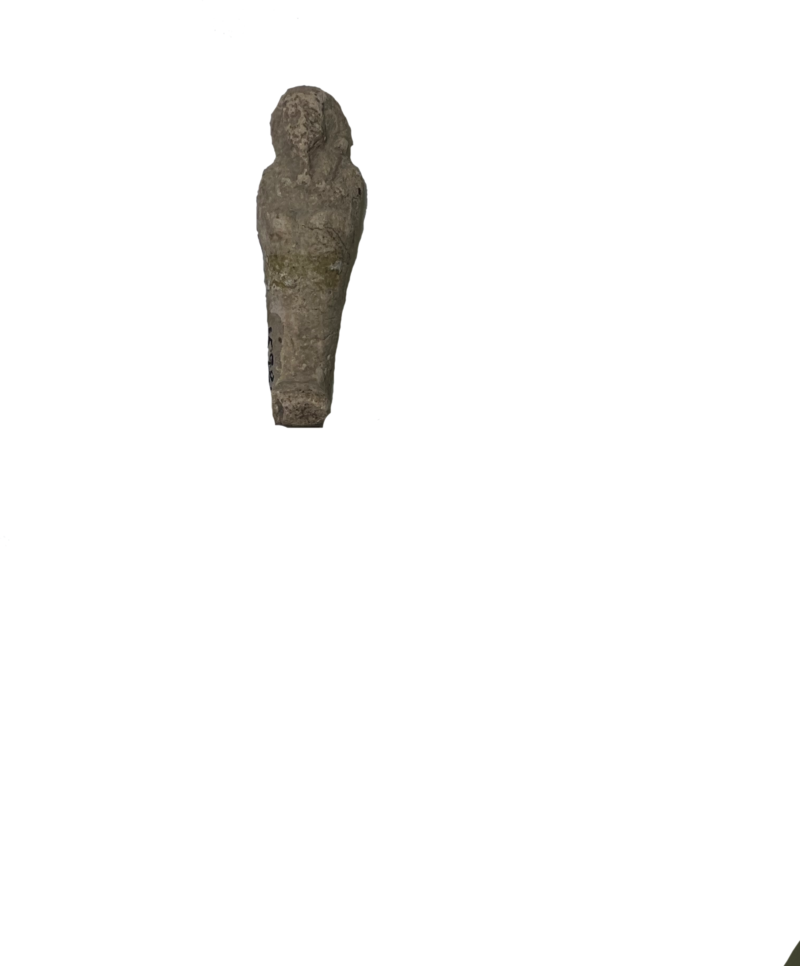
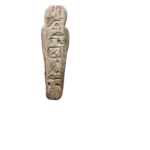
Small mummiform statuette, very worn on its front, made of faience with a whitish hue. The arms and hands can be made out, as well as the facial features and the false beard. Supposedly tripartite wig. The agricultural implements are not discernible. The back lacks a back pillar and bears a raised inscription that begins on the wig and descends to the feet.
Hieroglyphic transcription

Comments
The name Hathoremhat (meaning Hathor is at the fore) is a relatively uncommon female name, attested in only a few sources. We find it, for example, in the Zagreb Museum, on the funerary figurine of Neit-em..., whose mother is Hathoremhat; the determinative used for her name is the figure of a woman (Gardiner sign B1) 2. Another reference appears on the Serapeum stela IM4118, currently kept in the Louvre Museum. The stela belongs to Pasherienptah, whose mother bore the name Hathoremhat. A third reference is found in the Walters Art Museum, on the relief of Anjefensejmet (inv. 22.38), depicted together with his wife, also named Hathoremhat 3.
All three references date to the Late Period and seem to fall around the 26th Dynasty.
To date, we have not identified any parallel for this ushabti.
Hathoremhat
Ht-Hr-m-HAt
Current location
National Archaeological Museum, Madrid.
Inv. Nº
15986
Origin
Unknown
Material
Faience
Dimensions
5.6 x 1.7 x 1.3
Dating
Late Period (Dynasty XXX–Ptolemaic)
Bibliography
Unpublished
Typology
5.3.1 TC: Cl XIA6 W35a H30 I0 B0 Tp13c
Transliteration
sḥḏ Wsjr Ht-Hr-m-H3t m3a.t-xrw
Translation
Illumination of the Osiris Hathoremhat, justified.
Author of this record
©J.Uriach